
If you have explored your BaZi chart, you will have noticed that every element in it belongs to one of five categories: Wood, Fire, Earth, Metal, and Water. These are not symbols or metaphors. They are the operating language of Chinese metaphysics — the framework through which your birth chart is read, interpreted, and applied to real life.
The Five Elements are not unique to BaZi. They appear across Feng Shui, traditional Chinese medicine, I Ching divination, Qi Men Dun Jia, and martial arts. Understanding them is the single most important step in making sense of any Chinese metaphysical system.
What Are the Five Elements?
The Chinese term is Wu Xing (五行), which translates more accurately as “five phases” or “five movements” rather than “five elements.” Unlike the Western concept of elements as fixed substances, the Chinese Five Elements describe dynamic patterns of energy — how things grow, transform, consolidate, refine, and adapt.
Each element represents a distinct quality of movement:
Wood (木) represents growth, expansion, and upward movement. It is the energy of spring — new beginnings, ambition, and forward momentum. Wood pushes through obstacles the way a seedling pushes through concrete.
Fire (火) represents radiance, expression, and outward movement. It is the energy of summer — visibility, warmth, and connection. Fire illuminates, transforms, and draws attention.
Earth (土) represents stability, nourishment, and centring. It is the energy of late summer and seasonal transitions — the grounding force that holds everything together. Earth receives, supports, and sustains.
Metal (金) represents precision, structure, and inward movement. It is the energy of autumn — harvesting, refining, and letting go of what is no longer needed. Metal cuts through confusion and values clarity.
Water (水) represents wisdom, depth, and downward movement. It is the energy of winter — stillness, storage, and contemplation. Water flows to the lowest point, finding paths that others cannot see.
How the Five Elements Interact
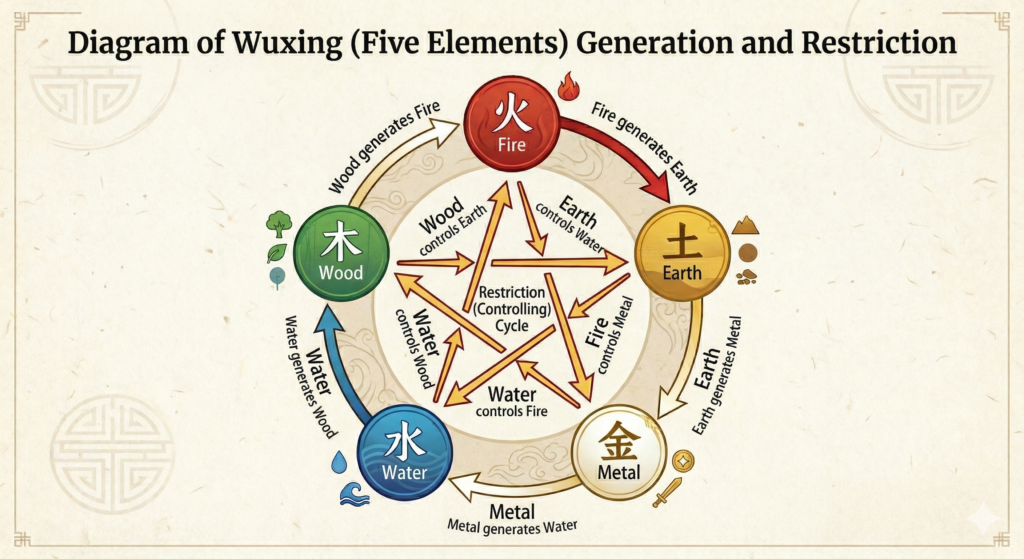
The elements do not exist in isolation. They relate to each other through two fundamental cycles that govern all interactions in your BaZi chart.
The first is the Generating Cycle (相生), where each element produces and supports the next. Wood feeds Fire. Fire creates Earth through ash. Earth produces Metal through compression. Metal generates Water through condensation. Water nourishes Wood through irrigation. This is the cycle of support, growth, and natural momentum.
The second is the Controlling Cycle (相克), where each element regulates and restrains another. Wood breaks Earth by sending roots through soil. Earth contains Water by forming banks and dams. Water extinguishes Fire. Fire melts Metal. Metal cuts Wood. This cycle is not destructive — it is regulatory. Without control, any element would grow unchecked and create imbalance.
When the elements in your BaZi chart follow the Generating Cycle, life tends to flow with less resistance. When they follow the Controlling Cycle excessively, friction and challenge arise. A skilled practitioner reads both cycles simultaneously to understand the dynamics at play.
The Five Elements in Your BaZi Chart
In your Four Pillars chart, every Heavenly Stem and Earthly Branch carries one of the Five Elements. Your Day Master — the Heavenly Stem of your Day Pillar — is your core element. All other elements in the chart are interpreted relative to it.
The balance of elements in your chart reveals several things. An element that appears frequently indicates a natural strength or dominant life theme. An element that is weak or absent points to areas that require conscious effort or external support. The relationship between your Day Master element and the other elements determines your Ten Gods — the system that maps career, wealth, relationships, creativity, and authority in your chart.
For example, if your Day Master is Geng Metal, then Wood in your chart represents Wealth, Fire represents Authority, Earth represents Support, Water represents your creative Output, and other Metal represents Companions or competition.
Five Elements and Health
Each element corresponds to specific organ systems in the body. This connection is foundational to traditional Chinese medicine and offers practical insight from your BaZi chart.
Wood governs the liver, gallbladder, eyes, and tendons. When Wood is excessive, irritability and tension headaches may arise. When deficient, vision problems or joint stiffness may develop.
Fire governs the heart, small intestine, tongue, and blood vessels. Excess Fire can manifest as anxiety, insomnia, or inflammation. Deficient Fire may present as poor circulation or lack of motivation.
Earth governs the stomach, spleen, muscles, and mouth. Excess Earth can lead to overthinking and digestive sluggishness. Deficient Earth may cause poor nutrient absorption or weak immunity.
Metal governs the lungs, large intestine, skin, and nose. Excess Metal can manifest as rigidity or skin conditions. Deficient Metal may present as respiratory weakness or chronic colds.
Water governs the kidneys, bladder, bones, and ears. Excess Water can manifest as fearfulness or fluid retention. Deficient Water may cause lower back pain, fatigue, or hearing difficulties.
Five Elements and Feng Shui
The Five Elements are equally central to Feng Shui practice. Each direction, colour, shape, and material in your environment carries elemental energy.
East and Southeast carry Wood energy. South carries Fire energy. Southwest, Northeast, and Centre carry Earth energy. West and Northwest carry Metal energy. North carries Water energy.
By understanding which elements are strong or weak in your BaZi chart, a Feng Shui practitioner can adjust your living or working environment to compensate — adding supportive elements or reducing excessive ones.
Five Elements and Timing
The Five Elements cycle through time as well as space. Each year, month, day, and hour carries its own elemental signature. The year 2026 (Bing Wu / Fire Horse) carries strong Fire energy, which interacts differently with each person depending on their chart.
Your ten-year Luck Pillars also carry elemental energy that shifts every decade. Understanding which element dominates your current Luck Pillar — and whether it supports or challenges your Day Master — is one of the most practical applications of Five Element theory.
Discover Your Five Elements Balance
Your free BaZi chart shows exactly how the Five Elements are distributed across your Four Pillars. Enter your birth date and time to see which elements are dominant, which are weak, and how they interact with your Day Master.
If you want to understand how to apply Five Element theory to specific decisions — career direction, relationship timing, health management, or Feng Shui adjustments — a personal consultation can provide targeted guidance based on your unique chart.
Your Day Master element is the most important. It represents your core self. All other elements in the chart are interpreted in relation to your Day Master through the Ten Gods system.
Your birth chart elements are fixed. However, you can introduce supportive elements through your environment (Feng Shui), clothing colours, career choices, diet, and timing of important decisions.
A missing element does not mean weakness in all cases. It often indicates an area of life that requires more conscious attention. The missing element may also appear through Luck Pillars or annual cycles at different stages of life.
