
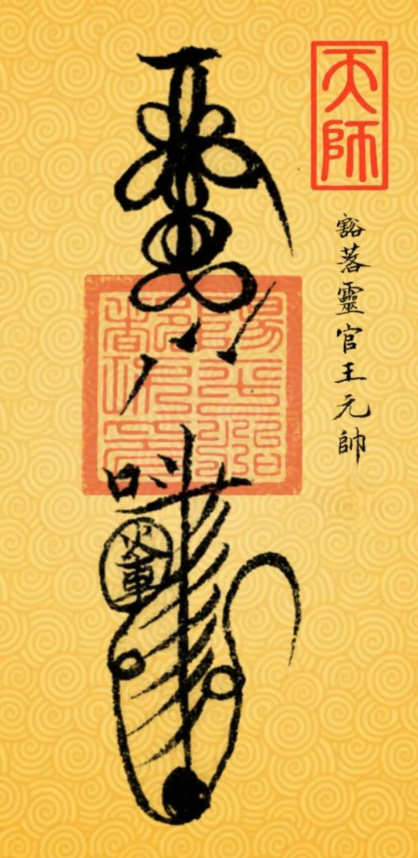
You may have seen Chinese talismans in films: strips of yellow paper marked with mysterious red brushstrokes and used by Daoist priests to ward off harmful forces. However, Chinese talismans are far more than cinematic props. In fact, they represent one of the oldest and most sophisticated spiritual technologies in the world, with a recorded history of more than two thousand years.
In Chinese, people call a talisman Fu (符). The art of creating and consecrating these talismans is called Fulu (符箓), which literally means “talismanic script.” Moreover, this practice stands at the heart of several major Daoist traditions, especially the Zhengyi (正一) and Tianshi (天師) lineages.
At Lumen Tao, we hand-draw every talisman in this classical tradition. Therefore, this article explains what a Fu is, how it works, how practitioners create it, and why authenticity matters so deeply.
What Is a Chinese Talisman (Fu)?
A Fu is a spiritual document written for a specific ritual purpose. It is not decoration, ordinary calligraphy, or a generic good-luck charm. Instead, it combines sacred symbols, divine names, seal marks, and ritual strokes into a structured form of communication between the human and celestial realms.
You can think of a Fu as a formal petition to spiritual authorities. In other words, the practitioner writes a request, empowers it through lineage authority, and seals it with ritual intent. As a result, the symbols on a Fu are never random. Each stroke carries a precise function within the tradition. At the same time, the script remains deliberately esoteric because it is meant for the divine realm rather than for ordinary reading.
The earliest references to Fu appear in texts dating to the Han Dynasty (202 BCE–220 CE), for further background, the Wikipedia article on Fulu provides a useful historical overview, though the practice almost certainly predates these records. By the time of the Eastern Jin Dynasty (317–420 CE), the scholar Ge Hong noted in his Baopuzi that a talisman’s power did not depend on the user’s ability to read its script — only on the authenticity of its inscription and the authority of its creator.
How Is a Chinese Talisman Created?
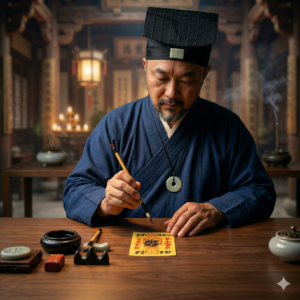
An authentic Fu comes into being through ritual, not casual writing. For that reason, a genuine talisman differs completely from a decorative paper charm.
First, the practitioner prepares through purification. This stage often includes fasting, meditation, and abstaining from certain foods or activities for a set period. Through this preparation, the practitioner clears and focuses their energy before beginning the work.
Next, the practitioner prepares and consecrates the altar. They cleanse the ritual space, remove negative influences, and formally invoke the presiding deities of their lineage. In classical Daoist practice, this step does not serve as a mere symbol. Instead, the practitioner invites real spiritual presence and participation into the ritual.
Then, the practitioner draws the talisman by directing cultivated Qi (氣) through the brush and into the paper. As they write, they use specific incantations, ritual hand gestures, breath control, and concentrated intention. Consequently, they do not draw the symbols like ordinary written characters. They inscribe them as sacred forms charged with spiritual authority.
Finally, the practitioner seals and activates the completed Fu. Depending on the lineage and ritual method, this may involve a final gesture, a seal, or an act of consecration. Only after this final stage does the talisman become spiritually active.
What Does a Chinese Talisman Do?
A Fu can serve many purposes, depending on its design and the intention behind it. For example, some talismans focus on protection and help guard against harmful influences, negative energy, or spiritual disturbance. Others support prosperity by attracting favourable conditions for wealth, business success, and financial stability. In addition, some talismans promote harmony in relationships and environments, while others support health by addressing energetic imbalance.
In Daoist understanding, a Fu works through resonance. More specifically, the cosmos moves through patterns of Qi, and a properly inscribed talisman aligns with a particular energetic pattern. Because of this, it can strengthen beneficial influences or neutralise harmful ones within a person, home, or situation.
Importantly, this is not abstract theory. It is the same principle that underlies acupuncture, Feng Shui, and traditional Chinese medicine — all of which work by identifying and adjusting the flow of Qi to restore balance. The Five Elements theory that governs these systems also informs the design and application of talismans.
Why Authenticity Matters
Today, many sellers offer talismans online. A simple search reveals countless printed or mass-produced Fu sold for only a few dollars. Often, sellers market them as generic lucky charms alongside crystals, incense, and decorative spiritual goods.
However, appearance alone does not make a real talisman. Although these products may resemble authentic Fu, they usually lack the essential elements that give a talisman spiritual force.
First, an authentic Fu requires lineage authority. The practitioner must train within a recognised tradition and receive permission to create talismans through that lineage.
Second, an authentic Fu requires ritual consecration. The practitioner must create it through the proper ritual process rather than print it from a template.
Third, an authentic Fu requires specific intention. A true talisman is made for a real person, a defined purpose, or a precise need. Therefore, the practitioner directs focused spiritual intent into the work at the time of creation.
Without these elements, a talisman remains only paper and ink. It may still look beautiful, but it does not carry the same spiritual charge. In that sense, a photocopy of a prescription may resemble the original, yet it cannot deliver the medicine itself.
The Lumen Tao Approach
Every talisman offered through Lumen Tao is hand-drawn by Dr. Jason E, a lineage holder in four classical Daoist traditions including the Zhengyi Tianshi tradition, the Sanshan Dixue tradition, and the Longmen tradition of Quanzhen Daoism.
Each talisman is created through the traditional ritual process described above — purification, altar consecration, invocation, and energetic activation. No two talismans are identical, because each is inscribed with the specific intention appropriate to its recipient.
This is what distinguishes a Lumen Tao talisman from a mass-produced charm. It is not a product in the commercial sense. It is a spiritual document, created within an unbroken lineage of practice, and consecrated with genuine ritual authority. This is what makes each Chinese talisman from Lumen Tao a genuine spiritual instrument.
How to Use a Talisman
Once you receive your talisman, treat it with respect. Common practices include carrying it on your person in a wallet, purse, or pocket close to your body; placing it in a specific location in your home or workplace such as above a doorway, inside a drawer, or near your bed; and keeping it clean and undamaged.
A talisman is typically replaced once a year. The old talisman should be respectfully burned or returned to the practitioner, and a new one obtained for the coming year. This renewal ensures that the energetic charge remains fresh and aligned with your current circumstances.
Explore Our Talismans
If you are drawn to the idea of carrying authentic spiritual protection, explore our hand-drawn talisman collection. Each talisman is created specifically for its owner within the classical Daoist tradition.
For guidance on which talisman is most appropriate for your current situation, you are welcome to contact us or book a consultation where we can assess your needs based on your BaZi chart and current circumstances.
A talisman is typically effective for one year. It should be respectfully burned or returned to the practitioner at the end of each year and replaced with a newly consecrated one to maintain its energetic charge.
In classical Daoist practice, a properly consecrated talisman carries its own spiritual charge regardless of the user’s beliefs. However, respectful treatment and sincere intention on the part of the recipient are considered beneficial to the process.
A hand-drawn talisman is created through a complete ritual process by an authorised practitioner within an established lineage. A mass-produced talisman is printed from a template without ritual consecration, personal intention, or lineage authority. The visual appearance may be similar, but the spiritual content is fundamentally different.
